Physical Address
304 North Cardinal St.
Dorchester Center, MA 02124
Physical Address
304 North Cardinal St.
Dorchester Center, MA 02124
Transform Your Digital Vision with ITServiceLK
Transform Your Digital Vision with ITServiceLK
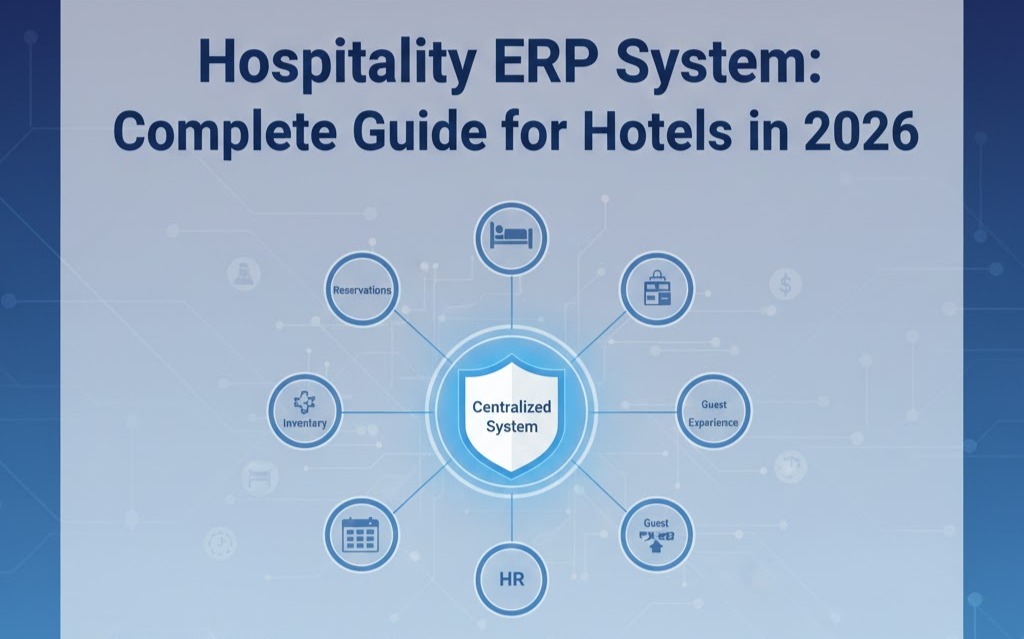
The hospitality industry is evolving rapidly, and technology is no longer optional. A modern Hospitality ERP System has become the backbone of efficient hotel operations in 2026.
From managing reservations and finances to inventory, HR, and guest experience, hotels now require centralized systems that eliminate manual work and improve decision-making. Whether you operate a boutique hotel, resort, or multi-property chain, implementing the right ERP solution can significantly increase operational efficiency and profitability.
This guide explains everything hotel owners and managers need to know.
A Hospitality ERP System (Enterprise Resource Planning) is an integrated software platform that connects all core hotel departments into one centralized system.
Unlike traditional property management systems (PMS), an ERP solution goes further by integrating:
Instead of working with separate tools or spreadsheets, all data flows through one platform. This reduces duplication, improves accuracy, and allows management to make data-driven decisions in real time.
The hospitality industry faces several challenges:
A Hospitality ERP System directly addresses these challenges.
All departments work on a single platform. When a guest checks in, billing, housekeeping, and CRM automatically update.
No more manual coordination.
Hotel managers can instantly view:
This helps improve cash flow management and budgeting accuracy.
Food, beverage, housekeeping supplies, and maintenance inventory can be tracked automatically.
The system can:
This is especially important for hotels with restaurants and event operations.
When selecting an ERP solution, look for these core features:
Handles reservations, check-in/check-out, room availability, and billing.
Automates accounting, tax calculation, invoicing, and financial reporting.
Stores guest preferences, visit history, and feedback for personalized service.
Ideal for hotel groups managing multiple branches from a central dashboard.
Access reports and manage operations from anywhere.
Performance dashboards for occupancy, ADR, RevPAR, and department profitability.
Many hotel owners confuse ERP with PMS.
Here’s the difference:
| Feature | PMS | Hospitality ERP |
|---|---|---|
| Room Management | ✔ | ✔ |
| Accounting | Limited | Full integration |
| Inventory | No | Yes |
| HR & Payroll | No | Yes |
| Procurement | No | Yes |
| Analytics | Basic | Advanced |
A PMS focuses mainly on front-desk activities.
A Hospitality ERP System manages the entire business ecosystem.
In 2026, most hotels prefer cloud-based ERP systems.
On-premise systems may suit large enterprises requiring strict local data control, but for most hotels, cloud ERP provides better flexibility and cost efficiency.
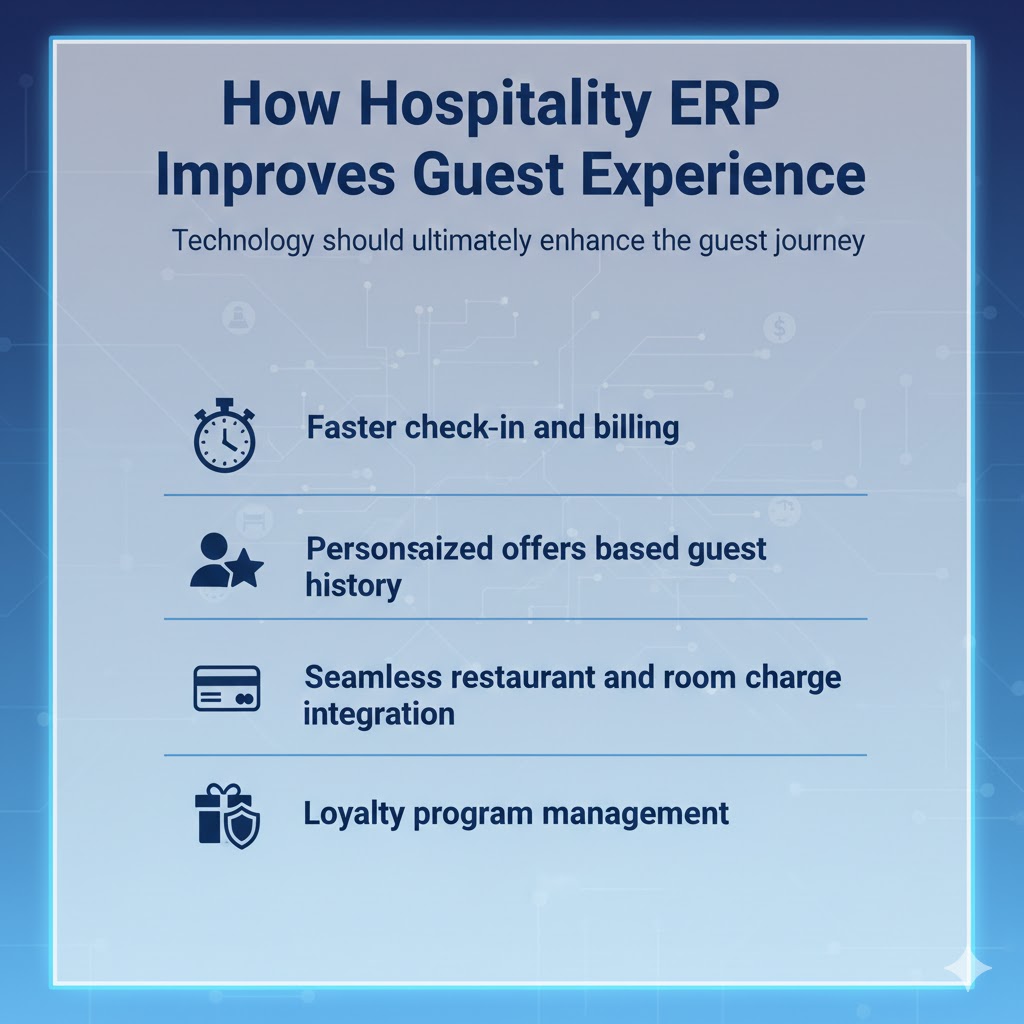
Technology should ultimately enhance the guest journey.
An ERP system enables:
When systems are connected, service becomes smoother and more professional.
Guests notice the difference.
Hotels handle sensitive data including:
A modern Hospitality ERP System includes:
Cybersecurity is not just IT responsibility — it protects brand reputation.
ERP implementation requires planning.
Hotels should evaluate:
Choosing a local technology partner who understands hospitality operations can significantly reduce implementation risks.
Yes.
Modern ERP systems are modular and scalable.
Small hotels can start with:
And later expand as business grows.
Digital transformation is no longer limited to large hotel chains.
It centralizes hotel operations, improves efficiency, and provides real-time financial visibility.
Costs vary depending on modules, cloud vs on-premise setup, and customization requirements.
Typically between 4 to 12 weeks depending on hotel size and system complexity.
The hospitality industry in 2026 is driven by technology, data, and operational efficiency.
A well-implemented Hospitality ERP System allows hotels to:
For hotels planning long-term growth, ERP is not an expense — it is an investment.